This story was originally published in Sapientia.
Chloé Zhao’s adaptation of Hamnet captures the beauty and grief of Agnes Hathaway (often known as Anne Hathaway), her husband William Shakespeare, and their family as they navigate the death of their son, Hamnet. The film, co-written by Zhao and Maggie O’Farrell and based on O’Farrell’s 2020 novel of the same title, examines the cruelest aspects of life with enchanting tableaus, powerhouse acting, and a surprising (though appreciated) dose of iambic pentameter.
Though it remains faithful to the book in most ways — aside from narrative structure changes — the centering of a Greek myth in the film adds a new layer to the visual and thematic storytelling.
Early in the film, and their relationship, Agnes asks a simple request of her future husband: Tell me a story.
Instead of spinning a tale of his own creation, as one might expect from the world’s most famous playwright, a youthful Shakespeare recounts the tragedy of Orpheus and Eurydice. In short, Orpheus, a bard, travels into the underworld to rescue his love, the nymph Eurydice, from eternal death. His music was so lovely that he charmed Cerberus, the fearsome guardian of the Gates of Hell, and was even granted the favor of Hades himself, master of the underworld. The only condition of Eurydice’s freedom was that Orpheus must guide her out by walking ahead of her and never looking back. He must trust that she would be there behind him when he reentered life above ground. But at one point, when Orpheus couldn’t hear her footsteps, he stole a glance over his shoulder. Eurydice was, in fact, following close behind. His lack of faith condemned her to an eternity in the underworld.
That the Orpheus tale was not in the novel does not mean it was not part of Shakespeare’s creative genius, as shown by the fact that he used it in one of his later plays, Henry VIII:
Orpheus with his lute made trees,/And the mountain tops that freeze,/Bow themselves when he did sing:/To his music plants and flowers/Ever sprung; as sun and showers/There had made a lasting spring./Every thing that heard him play,/Even the billows of the sea,/Hung their heads, and then lay by./In sweet music is such art,/Killing care and grief of heart/Fall asleep, or hearing, die. (Henry VIII, III.I)
Credit: Agata Grzybowska / © 2025 FOCUS FEATURES LLC
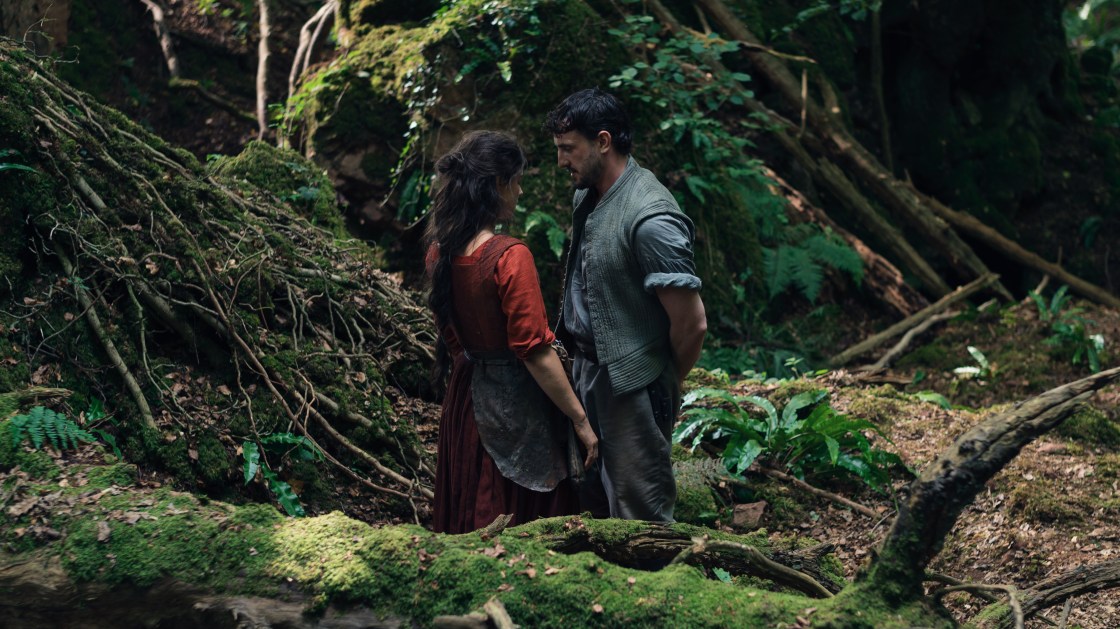
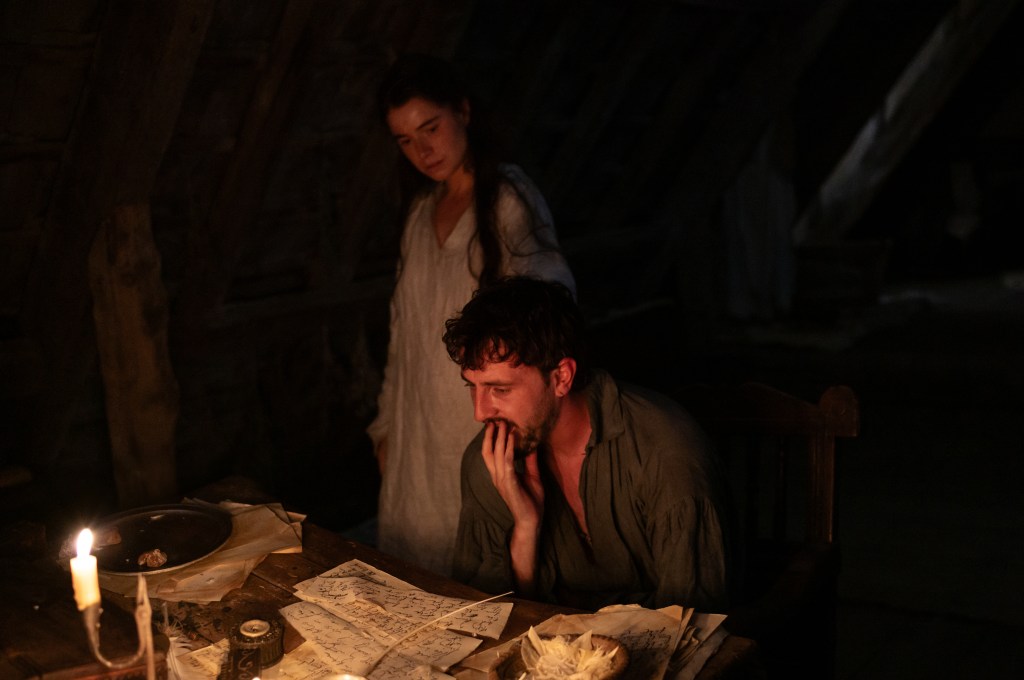
By placing the myth early in the film, Zhao makes the parallels between William and Agnes and Orpheus and Eurydice obvious. He is a poet, lost in thoughts and daydreams, burdened by his obsession for his art; she is a free spirit rooted in the forest, one with the elements and in touch with the natural world. The first shot we see of Agnes is of her curled up on the forest floor, held in its womb, watching her pet hawk fly overhead, whereas William is first shown looking out of a second-story window, bored by his work as a tutor.
As the film progresses, “Look at me” becomes a refrain between the couple, turning the tragedy of Orpheus and Eurydice on its head. They each long to be seen, to be known by the other.
On their wedding day, a young William Shakespeare walks down the aisle ahead of Agnes. When she offers these three words to him – “Look at me” – he turns. Unlike the Orpheus story of Eurydice, Agnes remains within reach, but it marks the beginning of their own descent into — and eventual escape from — a hell created by the death of their 11-year-old son, Hamnet.
Credit: Agata Grzybowska / © 2025 FOCUS FEATURES LLC
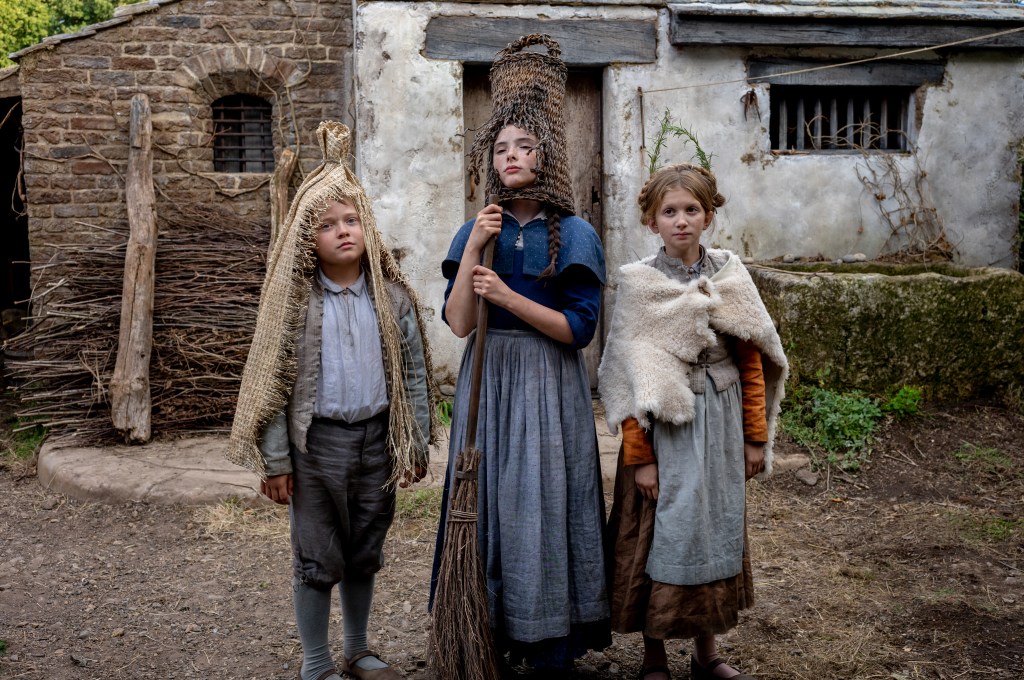
Hamnet’s death is not withheld as a surprise or a twist. That Shakespeare had a son who died as a child is well enough known, as is his great (nearly) eponymous tragedy, Hamlet, which should serve as enough of a clue that Hamnet wouldn’t be a happy-go-lucky story about the Shakespeare clan, à la Full House. But in the novel and the movie, neither Maggie O’Farrell nor Chloé Zhao left any room for doubt. Both the novel, which features the subtitle “A Novel of the Plague,” and the film open with a quote from the New York Review of Books’ article “The Death of Hamnet and the Making of Hamlet” (the title of which is provided quite clearly in both the film and the book):
“Hamnet and Hamlet are in fact the same name, entirely interchangeable in Stratford records in the late sixteenth and early seventeenth centuries.”
In the book, there are some 70 pages that examine the grief that follows Hamnet’s death, particularly the silence that he leaves behind. Agnes is constantly searching for him, waiting for a sign of his enduring presence.
In the film, this prolonged grieving period, including Hamnet’s funeral, are scrapped to give a larger breadth to Agnes’ experience attending a production of Hamlet in London. Still, the film establishes Agnes’ search for her son and the fact that she can no longer feel him in their house as integral to her mourning. William, too, says he cannot conceive of the fact that his spirit is simply gone.
Their grief serves as a catalyst for the growing distance between them, and William quickly returns to London (where he spends a good portion of the film) after Hamnet’s death. His departure leaves with it a coldness and finality, and Agnes is certain that he doesn’t understand the pain of the loss, especially since he missed Hamnet’s last breath.
But when Agnes learns that her husband wrote a play entitled Hamlet, she takes off for London to see why he has appropriated their son’s name. Even as she watches the play unfold, she can’t see how her son has anything to do with a drama of kings and princes. It is not until William, portraying the ghost of Hamlet’s father, appears that she begins to understand the play, and her husband: that he too feels this loss at his very core, that even though his grief looks different from hers, it is fundamentally the same. Then, Hamlet steps out on stage (played by Noah Jupe, the older brother of Jacobi Jupe, who played Hamnet) and she sees her son in the flesh — or who he could have become had he been allowed to grow up.
Credit: Courtesy of Focus Features / © 2025 FOCUS FEATURES LLC
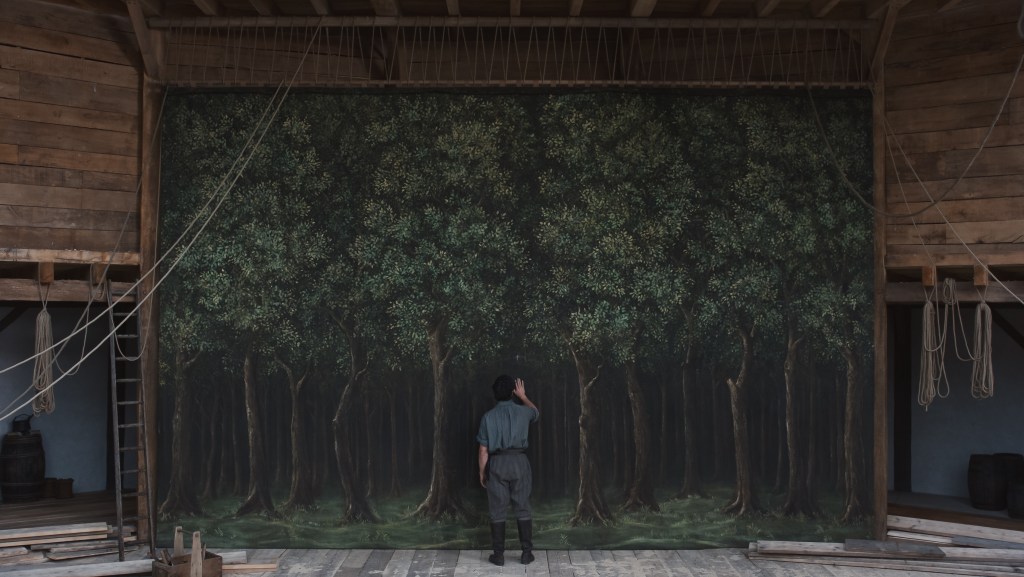
In one of the final moments of the film, Agnes calls those three words out to her husband once more: “Look at me.” In that instant — him just off-stage at The Globe, her in the front row of the crowd of Hamlet — they are united in their loss, and they recognize the other’s suffering. It is then that a vision of their late son, framed against a black cutout in the forest-painted set, appears to them. With a smile over his shoulder, Hamnet looks back at them before stepping into the darkness. William, Hamnet, and Agnes — father, son, and spirit — find their way back to one another.
In the end, Agnes and William seeing each other is precisely what saves them.

