This story was originally published in Sapientia.
Photo: Leo Sorel / Fordham Center on Religion and Culture
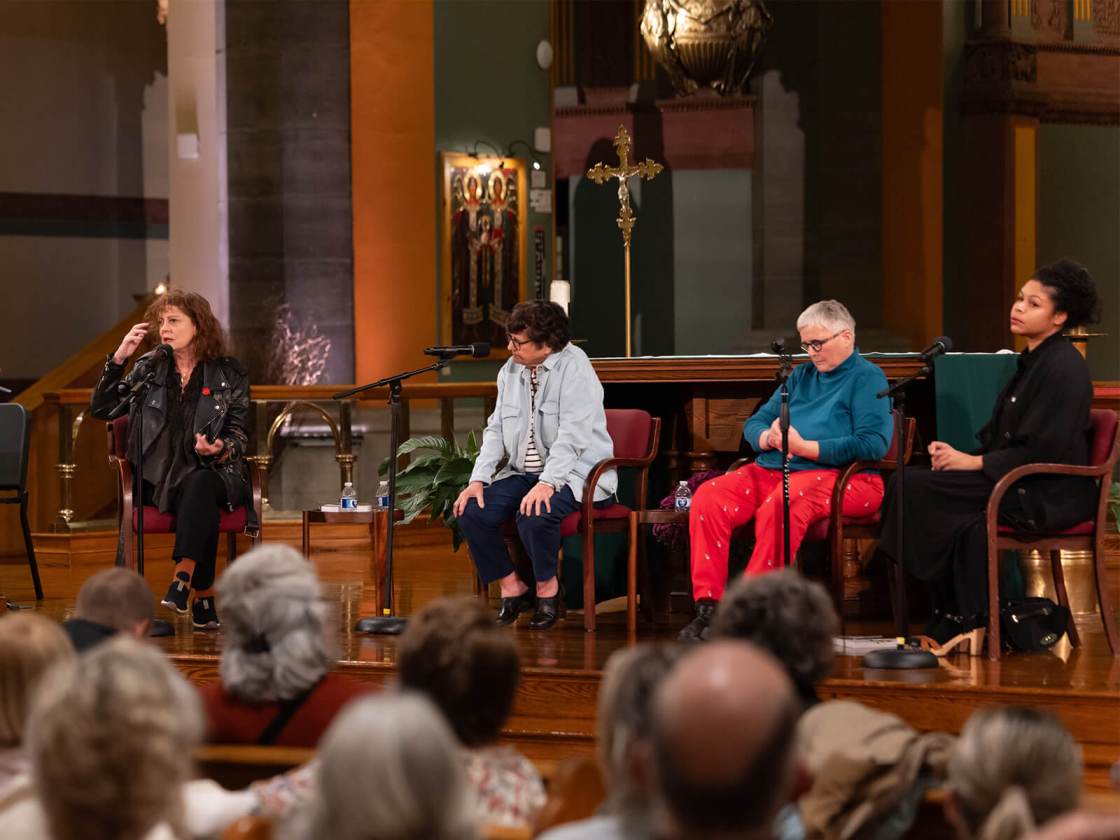
Seated at the foot of the altar at St. Paul the Apostle Church in Manhattan, four women preached the gospel of Dead Man Walking, the 1993 memoir by Sister Helen Prejean, at the New York book launch for the graphic edition of the story.
Dead Man Walking is Sister Helen’s firsthand account of her journey as spiritual advisor to death row inmates Patrick Sonnier and Robert Willie, an experience that propelled her into fierce advocacy for criminal justice reform – and inspired an award-winning movie, opera, play, and now a graphic version. Response to the event was so strong that it had to be moved from Fordham’s Lincoln Center campus to the larger space at St. Paul’s next door.
Sister Helen was joined by Rose Vines, the writer who scripted the graphic edition, Catherine Anyango Grünewald, the illustrator, and Susan Sarandon, the actress who won a 1996 Academy Award for her portrayal of Sister Helen in the film adaptation. Fordham University’s Center on Religion and Culture hosted the November 6 event, and its director, David Gibson, moderated a conversation on art, adaptation, and activism.
As they explored the inspiration behind the graphic edition — a project that spanned six years — it became clear that Dead Man Walking not only finds relevance, but deepens its resonance with each new iteration. It’s like Marshall McLuhan said: “The medium is the message.” And that certainly holds true for Dead Man Walking. In each version, be it the 1993 memoir, the 1995 film, the opera in 2000, the play in 2002, or the graphic edition in 2025, each adaptation adds its own context to the story, largely as an effect of the format it’s being told in, bringing it into the eyes and hearts of a new audience and generation.
In the opera, it’s a minute-and-a-half of silence as the execution takes place; in the most recent adaptation, it’s the adoption of a visual language to reimagine the story.
“This adaptation shouldn’t be a xerox copy of the book,” said Catherine. “It needs to have a point of view or it needs to lead people into the story in a different way.”
“Images affect people differently than prose. … My process was mostly to think about how visual language could affect the reader in a new way.”
She said that she explored the use of grids and bodies in her design to capture the “unnatural feeling of incarceration,” and to provoke an emotional or empathetic response among readers.
Inspiring such sentiments is at the heart of Dead Man Walking and the activism that surrounds it. Sister Helen attributes much of the support of the death penalty to the disconnect that exists between what happens in the execution chamber and people’s perception of it.
“I know that the heart of the American people that I’ve experienced is that people are good,” said Sister Helen. “They really don’t want it [the death penalty], but they’re separated from it. And you’ve got to bring them close and they get it. And that is my hope. It really is my hope.”
This hope moves closer to fruition as time goes on. When the book first came out, Rose said, national support for the death penalty was around 80 percent, higher still in Sister Helen’s home state of Louisiana. Now, it sits in the 50 percent range, and juries have significantly decreased their death sentence decisions. Still, there have been 41 executions in the U.S. this year.
That’s one reason why Sister Helen met with some 30 Fordham law school students earlier in the day for a discussion over lunch. It’s not just about changing hearts and minds, she said; murder suspects and death row inmates need strong legal representation to have any chance of neutralizing the racial and systemic bias built into the system.
Catherine, who grew up in Kenya and lives in Sweden, said she previously believed the western world to be “a place of order and justice.” But as she began to research the Belgian colonization of the Congo for her graphic novel adaptation of Heart of Darkness by Joseph Conrad, and later working on Dead Man Walking, she discovered that “the systems that we live by or that we are taught we must live by are not infallible.”
“What I realized reading Sister Helen’s book and Heart of Darkness was that crime is awful, but when the law is also wrong, that’s a different kind of horror.”
Rose, who is Australian and lives in the United States, reflected on the distinction between the two countries, pointing to their founding as fundamental in the development of their legal and justice systems. Whereas Australia was founded as a convict settlement and promotes a kind of “forced egalitarianism,” she attributes America’s “puritanical ideas of good and evil” as formative in its belief that “there are evil people, and they must be cast out.”
Each of the four women grappled with the dark underbelly of America’s justice system as they explored Dead Man Walking and the death penalty through their respective projects.
“I remember Sister Helen saying — I think it’s in the movie, too —you just can’t get your head around it, that a state is going take a person and just kill them,” said Susan Sarandon. “It’s hard to even really experience what that means. It just defies logic.”
In her explanation for what called her to this story, Susan said that two points stuck with her after reading Sister Helen’s book.
“First of all, that this nun kept making mistakes. I thought that was really interesting because she didn’t just go into this issue as a heroine, you know? She was making mistakes as we all do.”
“And secondly … it was a love story, and it was questioning, ‘who can love unconditionally?’ And I came to the conclusion that religious people do that.”
Through all of its iterations, Dead Man Walking remains a kind of “conversion story,” as David Gibson aptly described it during the event. Sister Helen, guided by her faith, compassion, and love, found herself at the heart of a movement.
“I was charitable, I was kind, but I didn’t know anything about justice,” she said.
“And it was an awakening to justice and moving in among poor and struggling African American people that really set me on fire.”
That certainly resonated with the several hundred people who attended, as many of them waited more than an hour on line for Sister Helen and her co-authors to sign books.

